America’s 250th birthday year has come with more than just extra fireworks. The nation’s semiquincentennial has also come with a call for more community service: America250 aims to make 2026 the largest year of volunteerism in U.S. history.
But getting Americans involved in their communities is more challenging than it seems: While more than 74% of Americans think that they can make a positive impact in their local communities, only six percent are actually leading a project, according to a 2025 national survey the LOR Foundation conducted with Gallup. LOR undertook the poll to better understand the motivations and barriers to local people stepping forward to help their communities. That understanding is especially critical in places where limited services and support mean that encouraging local leadership is essential to creating thriving communities. Without local people investing their time and passion into things that help their communities—coaching a little league team, volunteering at a food pantry—many communities would simply go without these important assets. Targeted investment from funders is critical in helping unleash that leadership potential by supporting the conditions that inspire action—and even more people to step forward.
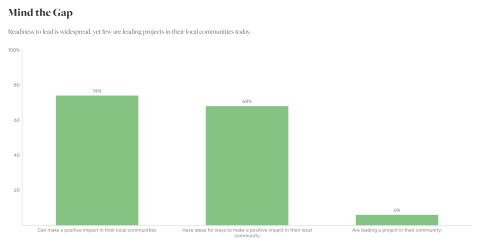
The gap between believing you can make a positive impact and leading also presents potential, especially when you consider that 66% of Americans say that easier access to financial support would increase their likelihood of leading a project. But funding isn’t the only motivator—and it might not even be the most important thing.
The Gallup survey revealed that what really seems to play a role in getting folks involved is whether they feel like they live in a cohesive community. People who feel connected, valued, and supported by their communities are three times more likely to report being motivated to lead a project to help their neighbors. And many of the social factors that contribute to people feeling connected are things that as funders we can—and should—support to change the math on getting more people involved.
As an organization that works directly with rural communities, we see it every day. Rural communities have less to work with: Government is smaller, there are fewer nonprofit service organizations, and fewer financial resources altogether—consider, for instance, that only 3% of philanthropic funding finds its way to rural places. And yet, in the past few years, LOR has funded more than 2,000 projects in the eight small towns where we work—each one led by a person who had an idea for helping their community and the willingness to lead. Here’s what we’ve learned about how to help locals move from intention to action.
Tip 1: Make getting funding easy and fast.
The Gallup survey revealed that 69% of Americans say the biggest barrier to leading a project is not having financial support. And nearly as many (66%) say not having time is another big blocker. So finding ways to make accessing funding easier—and faster—removes those obstacles. Easier can mean a lot of things: moving quickly, nixing application deadlines (or applications altogether), fewer reporting requirements and red tape.
For LOR, it means all of them. We’re agnostic about how people want to connect about their idea; LOR community officers will talk through grant ideas over email, phone, in person, or even a text message. We’ve seen grants come together over a cheeseburger, on the sidelines of a soccer game, even in a series of text messages. And almost all of LOR’s grants go out the door in less than 30 days; most people have a check in the mail within two weeks of bringing their idea to LOR. This speed and flexibility make it easy for folks to start working on their project when they feel inspired—instead of waiting for six months for the close of the next grant cycle.
Having grants that feel, well, human-sized, can also encourage people to take action. Often the good idea a mom, dad, or local teacher comes up with doesn’t require a million-dollar grant; something in the $10,000 range is frequently enough. That dollar amount can be less intimidating for an individual; there’s something about pulling off a $10,000 project that feels more doable than one that requires $1 million. Human-sized grants are a risk management strategy for funders, too, because they can streamline due diligence and move more speedily.
Tip 2: Give encouragement—and examples.
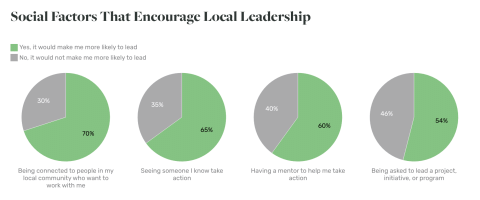
The Gallup survey also revealed that 54% of Americans say just being asked to lead a project would make them more likely to lead. So ask! But not just on your website or through other philanthropic networks. Get to the people you want to help step forward by going where they are—community concerts, parades, soccer games, potlucks. Reach out to the entities that are regularly in contact with people on the ground who have ideas—school districts, libraries, clubs, city government, senior centers. Not only are these organizations pathways to people, they also can serve as partners and mentors, and the national Gallup data showed us how important those roles are: 58% of Americans say part of the reason they aren’t leading a project is because they don’t know how to get started and another 60% say having a mentor would make them more likely to lead.
LOR saw firsthand how important local conduits like teachers, coaches, and city staff can be in its six years of working with Lander, Wyoming. In that time, over 300 locals led more than 500 community projects supported with funding from LOR; many of those locals came to LOR by way of a mentor or another trusted community member. “There are so many people with great ideas in town who struggle to get over the initial hurdle,” Lander, Wyoming, resident Alyssa Welch said. “Just having someone say, ‘That’s a good idea! I support you. You’ve got this.’ LOR helped many folks clear that hurdle!”
Tip 3: Connect folks to others.
Seventy percent of Americans say that being connected to people in their local communities who want to work with them is a key motivator for leading a community project. So finding ways to bring people together isn’t just a nice to have; it is the essential ingredient. Those points of connection can be as simple as organizing a day of lawn games in the park or encouraging neighbors to tailgate together at the high school football game. And sometimes building those connections can be more intentional. In LOR communities, every couple of months, we invite all of the folks who have recently led a community project to a social event (that we pay for)—a bingo lunch, a happy hour, a film screening—and we encourage them to bring a friend. We take a few minutes to acknowledge the projects and the people behind them—and frequently, some of those new faces become project leaders themselves.
There is perhaps no better human embodiment of this phenomenon than Lander, Wyoming’s Amanda Shade. Amanda Shade had never applied for a grant when she met LOR community officer Ami Vincent in 2022, but by the time LOR left Lander in June, she’d led nine and she inspired another 11 people to step forward and lead their own. “One project springs off five you don’t see,” Shade said. “It’s so cool to see what other people—people I never would have expected—are doing, things I never would have thought of. And to see what it does for them: You’re not just doing your project; you really get something from connecting to your community.”
To learn more about LOR’s survey with Gallup, or other tips for how to get more Americans involved in community work, email connect@lorfoundation.org.
The views and opinions expressed in individual blog posts are those of the author(s) and do not necessarily reflect the official policy or position of the National Center for Family Philanthropy.