Resources & Tools
Our resource library is home to hundreds of resources on the practice of effective family philanthropy, including a diverse range of reports, articles, guides, tools, and sample policies. We encourage you to search and explore the library by clicking below.
Have a specific question in mind?
Search our full resource libraryNot sure where to start?
Explore our featured resourcesThe Family Giving Lifecycle
While every philanthropic journey is unique, there are points at which all families must make decisions. The NCFP Family Giving Lifecycle provides the tools you need to make decisions that lead to effective outcomes at each stage of your philanthropic lifecycle.
Learn More

Search Resources & Tools
Filter results
November 2025: Network News
NCFP strives to connect its members to resources, best practices, and to peer funders. Network News highlights updates from our members and…
Generations of Giving: Leadership and Continuity in Family Foundations
Based upon a study of foundations in the United States and Canada that have survived through at least two generations, the authors ask…
Unlocking Doors: Relational Reparations, Shared Liberation, and the Healing Power of Story
CC Gardner Gleser shares the results of her NCFP fellowship project, which focused on relational reparations in family philanthropy and how funders can address harm in a way that is meaningful for all participants.
The Value of Capacity Building to Increase Nonprofits’ Impact
As nonprofits face federal funding cuts and a shifting regulatory environment, many funders are turning to capacity building to provide additional support and ensure sustainability of their grantee partners.
Sharing Power with Communities: A Field Guide
Through its work with nonprofits and foundations, Community Wealth Partners support the concept that those closest to the issues are also…
Investing in Capacity Building: Lessons from the Cedarmere Foundation
Relatively small amounts of money may be used by effective leaders to strengthen an organization’s people and infrastructure can be…
Practices for Engaging the Next Generation in Your Philanthropy
Leaders at multigenerational family foundations share successful ways to engage the next generation by providing meaningful opportunities to participate, sharing power, prioritizing learning, and more.
The Complete Guide to Family Philanthropy and Donor-Advised Funds
Families face choices when it comes to how to do their philanthropy. They give in different ways using different vehicles. Yet, behind every…
September 2025: Network News
NCFP strives to connect its members to resources, best practices, and to peer funders. Network News highlights updates from our members and…
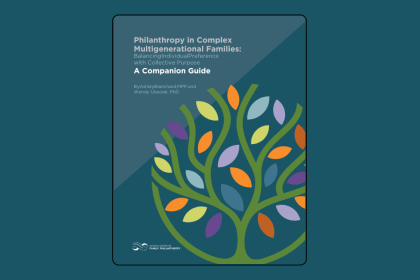
Philanthropy in Complex Multigenerational Families Report: A Companion Guide
This companion guide to the Philanthropy in Complex, Multigenerational Families: Balancing Individual Preference with Collective Purpose…
Social Impact Strategies: Intersectionality of Systems
How can philanthropic efforts go beyond addressing isolated challenges to fund the interconnectedness of social, economic, racial, and other…
August 2025: Network News
NCFP strives to connect its members to resources, best practices, and to peer funders. Network News highlights updates from our members and…
Using Your Voice and Influence to Complement Your Grantmaking
Funders can use their voice and influence to amplify their grantmaking, something that is particularly important as nonprofits face a dearth of funds. From signing pledges to signal solidarity and take action to bold peer-to-peer calls to action and transparent communication, family philanthropy is using its voice to meet the moment.
Planning for Effective Next-Generation Engagement
To improve its next-generation engagement and onboarding processes, the Sartain Lanier Family Foundation partnered with Grant Philanthropic Advisors to develop a ‘learning ladder’ that introduces the next generation to important skills and philanthropic knowledge and supports a smoother transition to board service.
July 2025: Network News
NCFP strives to connect its members to resources, best practices, and to peer funders. Network News highlights updates from our members and…
Social Impact Strategies: People and Place
How can a place-based approach maximize philanthropic impact and drive meaningful, community-led progress? In this session we will consider…
Ask NCFP: How do we set expectations about our funding capacity?
Being transparent and setting clear expectations about your funding capacity is necessary to be a good partner to your grantees, especially during times of uncertainty. But, even if you can’t sustain an increase funding, consider how your time, expertise, and connections can provide additional support to your nonprofit partners.
Looking Ahead: Opportunities for Family Philanthropy
How did we get here? Where do we want to go? Join NCFP’s president and CEO for a wide-ranging conversation on the state of the family…
How Family Philanthropies Can Support Community Organizing to Strengthen the Fabric of US Democracy
Family philanthropy is uniquely positioned to support a healthy democracy by funding community organizing, which often aligns well with their values and can fill funding gaps in meaningful ways, argues Loren McArthur.
From the Archive: Difficult Discussions at Difficult Times
NCFP’s From the Archive series highlights resources from our resource center that have stood the test of time and continue to provide…
The Time to Embrace Impact Investing is Now
Stacey Faella and Kathleen Simpson show the ways that impact investing has been a powerful tool at their foundations and offer advice to funders who want to explore new paths to support their grantees in light of funding gaps and significant need in the nonprofit sector.
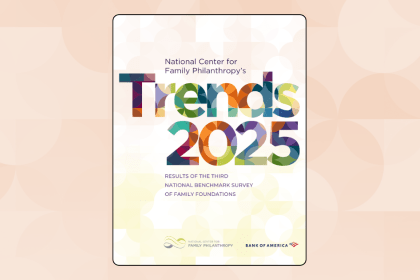
Trends 2025—Results of the Third National Benchmark Survey of Family Foundations
The Trends report captures and tracks leading trends in the field of family philanthropy. Conducted every five years, this research…
How Your Foundation’s Records Can Measure Impact, Manage Risk, and Promote Transparency
Your foundation’s information is an asset and managing that information with record and knowledge management—and perhaps an archives program—can help you preserve your family’s legacy, ensure that you’re complying with legal requirements, make your impact clearer, and help you live into values like accountability and transparency. While foundations have different goals that may inform their individual approach to information governance, Bob Clark argues that there are critical concepts that all foundations should consider.
CEO Performance Review (Anonymous Foundation)
An example of a CEO performance review from an anonymous foundation.Employee Benefits Administrative Committee Charter (The David and Lucile Packard Foundation, 2007)
An example of Employee Benefits Administrative Committee (ERISA Committee), from the David and Lucile Packard Foundation.Breaking Down Silos, Funding at the Intersection
A thriving democracy and reproductive rights are inextricably linked, argues Risa Kaufman. Here, she outlines how The Overbrook Foundation funds at this intersection and why funders who embrace the interconnected nature of today’s challenges can have greater impact.
More Family Foundations are Paying More than Five Percent Annually. Here’s Why.
NCFP’s Trends 2025 study showed that the majority of respondents are paying out more than five percent annually. Here, Maggie McGoldrick covers the various reasons that a funder might significantly increase their payout for a discrete period of time, including to make a big bet, account for programmatic shifts, or respond to a crisis.
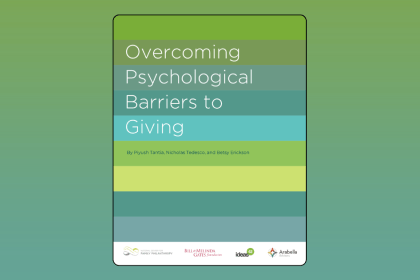
Overcoming Psychological Barriers to Giving
This report explores the behavioral science behind the ten most common barriers to giving—such as too many choices, fear of uncomfortable family dynamics, and lack of urgency—and provides effective and actionable ways for donors to overcome those barriers.
April 2025: Network News
NCFP strives to connect its members to resources, best practices, and to peer funders. Network News highlights updates from our members and…
Relationships and Power: Listening Well
Join us to explore how intentional practices of listening can help shift power between philanthropic families and their partners, within…
Trends in Family Philanthropy: Learnings for Effectiveness and Impact
What do the latest trends in family philanthropy tell us about effectiveness and impact? Join us to dive into select findings from the…
Family Giving Lifecycle: Fundamentals of Family Philanthropy
Learn about foundational topics in family philanthropy that will ground your practice throughout the rest of the Lifecycle, including managing conflict, decision-making frameworks, and the social impact landscape.
Family Giving Lifecycle: Succession and Legacy
This primer will help you and your family to define your philanthropic legacy, consider your philanthropy’s lifespan, and decide, if needed…
Family Giving Lifecycle: Operations and Management
This primer will help you and your family to draft a roadmap for efficient and effective operations. Download the primer above and explore…
Family Giving Lifecycle: Assessment and Learning
This primer will help you and your family to craft an assessment and learning plan to help define and measure the progress and success of…
Family Giving Lifecycle: Impact Strategy and Tools
This primer will help you and your family build a philanthropic strategy to achieve your desired social impact goals. Download the primer…
Family Giving Lifecycle: Governance
This primer will help you and your family to establish clear decision-making principles, policies, and practices to ensure long-term success…
Family Giving Lifecycle: Impact Vehicles and Structures
This primer will help you and your family to assess your options and understand which vehicles are best positioned to complement your goals…
Family Giving Lifecycle: Philanthropic Purpose
This primer will help you and your family to understand the core values and principles which drive you to give. Download the primer above…